Choosing the right webbing material is an important decision for manufacturers, product designers, purchasing teams, and OEMs. Nylon, polyester, and polypropylene are three of the most commonly used materials for woven webbing, but they do not perform in exactly the same way.
The right choice depends on the application, required strength, exposure to sunlight and moisture, flexibility, abrasion, chemical environment, expected service life, and overall product cost.
A webbing that works perfectly for a backpack may not be suitable for a safety harness. Similarly, a material that performs well in an outdoor application may not be the most economical choice for a lightweight bag or packaging product.
In this guide, we compare nylon webbing, polyester webbing, and polypropylene webbing to help you understand their key differences and select the right material for your application.
Property | Nylon Webbing | Polyester Webbing | Polypropylene Webbing |
|---|---|---|---|
Strength | High | High | Moderate |
Flexibility | Excellent | Very Good | Good |
Stretch | Higher | Lower | Low to moderate |
Abrasion Resistance | Excellent | Very Good | Moderate |
UV Resistance | Moderate | Excellent | Moderate |
Moisture Absorption | Higher | Very Low | Extremely Low |
Chemical Resistance | Moderate | Good | Excellent for many chemicals |
Weight | Moderate | Moderate | Lightweight |
Cost | Generally higher | Moderate | Generally economical |
Outdoor Performance | Good | Excellent | Application dependent |
Typical Applications | Safety, pet, outdoor, tactical | Automotive, safety, bags, outdoor | Bags, packaging, utility products |
The actual performance of a finished webbing depends not only on the fiber but also on yarn quality, denier, weave construction, width, thickness, finishing, and manufacturing process. Therefore, the table above should be used as a starting point rather than a substitute for application-specific testing.
Nylon webbing is a woven narrow fabric manufactured from nylon yarn. It is widely used where strength, flexibility, abrasion resistance, and energy absorption are important.
One of the major characteristics of nylon is its ability to elongate under load. This can be advantageous when the webbing needs to absorb or distribute sudden forces rather than transferring the entire impact immediately to connected components.
Nylon webbing is commonly considered for applications such as:
Pet collars and leashes
Harnesses
Outdoor equipment
Tactical equipment
Sports equipment
Backpack straps
Luggage
Industrial straps
Specialized safety products
Nylon is also known for good abrasion resistance and flexibility, making it useful in products that experience repeated movement or friction.
However, nylon absorbs more moisture than polyester and can experience changes in performance when wet. For applications exposed to continuous outdoor moisture or high UV exposure, polyester may be a better starting point.
Polyester webbing is a woven narrow fabric manufactured using polyester yarn. It is widely selected for applications where low stretch, dimensional stability, UV resistance, and low moisture absorption are important.
Compared with nylon, polyester generally stretches less and maintains more stable dimensions under tension. It also has very low moisture absorption, making it suitable for applications where the webbing may be exposed to water or changing weather conditions.
Common applications include:
Seat belt webbing
Safety harness webbing
Bag straps
Luggage webbing
Outdoor products
Automotive components
Industrial straps
Military equipment
Reflective webbing
Printed webbing
Polyester is particularly useful when the finished product needs consistent dimensions and relatively low elongation.
Polypropylene, commonly called PP, is a lightweight synthetic polymer used to manufacture economical and versatile webbing.
One of the biggest advantages of polypropylene webbing is its very low moisture absorption. Polypropylene is also resistant to many chemicals and is lightweight compared with many other webbing materials.
PP webbing is commonly used for:
Bags
Shopping bags
Backpacks
Luggage
Utility straps
Promotional products
Outdoor furniture
Packaging applications
General-purpose industrial products
Polypropylene can also float in water, which can make it useful in certain marine and water-related applications.
However, polypropylene generally does not offer the same combination of strength and abrasion resistance as high-quality nylon or polyester webbing. It is therefore important to select PP webbing according to the actual application and required performance.
The most common comparison in industrial webbing is nylon versus polyester.
Both can be manufactured into high-strength webbing, but their behavior under load and environmental exposure differs.
Nylon is often preferred when flexibility, abrasion resistance, and controlled elongation are important.
Its ability to stretch under load can help absorb sudden forces. This makes it attractive for certain dynamic applications where a small amount of elongation is desirable.
For example, nylon may be considered for:
Pet products
Outdoor equipment
Tactical equipment
Certain harness applications
Sports equipment
Products requiring a softer hand feel
Polyester generally offers lower elongation and better dimensional stability.
This makes it particularly useful when the strap needs to maintain its length and tension during operation.
Polyester is also a strong candidate for applications exposed to sunlight, moisture, and outdoor environments because of its low moisture uptake and good UV resistance.
Nylon and polypropylene are quite different materials.
Nylon generally offers higher strength and better abrasion resistance, while polypropylene offers lower weight, very low moisture absorption, and economical production.
Higher strength is required
Abrasion is a concern
Flexibility is important
The product experiences repeated movement
Shock absorption is beneficial
Low weight is important
Moisture resistance is important
Cost needs to be controlled
The application is not highly load-critical
Chemical resistance is important
The correct selection should always be based on the actual load, environment, construction, and required test performance.
Both polyester and polypropylene are widely used in bags, luggage, industrial products, and other commercial applications.
Polyester generally provides higher performance where tensile strength, UV resistance, dimensional stability, and long-term outdoor exposure are important.
Polypropylene has advantages where low weight, moisture resistance, chemical resistance, and cost effectiveness are priorities.
For example, a premium outdoor bag may benefit from polyester webbing, while a lightweight utility bag may use polypropylene webbing depending on its design requirements.
There is no single answer that applies to every webbing product.
People often ask:
"Is nylon stronger than polyester?"
or
"Is polyester stronger than polypropylene?"
The answer depends on the exact construction.
The tensile strength of finished webbing is affected by:
Fiber material
Yarn type
Yarn denier
Number of warp threads
Number of weft threads
Weave construction
Webbing width
Webbing thickness
Finishing process
Manufacturing quality
Therefore, two one-inch webbings made from the same material can have significantly different tensile strengths.
For industrial purchasing, it is better to compare the tested specification of the exact webbing construction rather than relying only on the name of the fiber.
For outdoor applications, polyester is often a strong starting point because of its low moisture absorption, low stretch, and strong resistance to prolonged UV exposure.
Nylon can still be an excellent choice where flexibility and abrasion resistance are more important than low moisture absorption.
Polypropylene can be suitable for outdoor products where low weight, water resistance, and cost effectiveness are important, although long-term UV exposure should be considered when specifying the product.
The final selection should always be based on the actual environment and expected service life.
All three materials can be used for bags and backpacks.
Nylon can provide a strong and flexible strap with a comfortable hand feel.
Polyester is suitable for bags where low stretch, color stability, outdoor exposure, and durability are important.
PP can be an economical option for lightweight bags, shopping bags, utility products, and applications where very low moisture absorption is beneficial.
For premium bags, the choice may also depend on appearance, printing requirements, color availability, texture, and brand positioning.
Pet collars, harnesses, and leashes require a combination of strength, flexibility, abrasion resistance, comfort, and appearance.
Nylon is commonly selected where flexibility and abrasion resistance are important.
Polyester is also an excellent option, particularly where color stability, low stretch, and outdoor exposure are important.
The final selection should consider the size and weight of the animal, product construction, stitching, hardware, expected usage, and applicable safety requirements.
Automotive restraint systems are safety-critical applications and should never be specified based solely on a general material comparison.
Seat belt webbing requires controlled performance, appropriate tensile strength, dimensional consistency, surface characteristics, and compliance with the relevant automotive requirements.
High-tenacity polyester is widely used in automotive seat belt webbing. D I PLAST INDIA offers high-tenacity polyester seat belt webbing in application-specific constructions.
For automotive applications, manufacturers should define the required specification, testing, and compliance requirements before production.
Safety harness webbing is another application where material selection and finished construction are critical.
Depending on the harness design and applicable standard, manufacturers may use high-strength polyester or nylon constructions.
The webbing should be evaluated for:
Tensile strength
Elongation
Abrasion resistance
Environmental exposure
Stitching performance
Dimensional consistency
Applicable safety standards
A safety harness should never be designed simply by selecting a material based on a generic online comparison.
Before placing an order, answer these questions:
Identify exactly where the webbing will be used.
Define the expected working load and required breaking strength.
If yes, UV resistance becomes an important selection factor.
If the webbing will regularly encounter water, polyester or polypropylene may offer advantages depending on the application.
Choose nylon when controlled elasticity may be beneficial. Consider polyester when low stretch and dimensional stability are priorities.
For applications involving repeated rubbing or movement, abrasion resistance should be evaluated carefully.
Identify the chemicals involved before selecting the fiber.
Material alone does not determine performance. Webbing construction is equally important.
Polyester is widely used for custom printed and sublimation applications because it can support vibrant designs and branding.
Define the required tensile, abrasion, color fastness, dimensional, or application-specific testing before production.
Choosing nylon, polyester, or PP is only the first step.
A professional webbing manufacturer can modify the finished product through:
Yarn selection
Weave design
Thread density
Width
Thickness
GSM
Finishing
Dyeing
Printing
Coating
Edge construction
This means that the same polymer can produce very different webbing products for completely different industries.
For example, D I PLAST INDIA's product range includes nylon, polyester, polypropylene, jacquard, seat belt, army belt, and other webbing constructions for different applications.
There is no universal "best" webbing material.
The right choice depends on what you expect the webbing to do.
Choose Nylon Webbing when you need:
High strength
Flexibility
Abrasion resistance
Controlled stretch
Shock absorption
Choose Polyester Webbing when you need:
Low stretch
Dimensional stability
UV resistance
Low moisture absorption
Long-term outdoor performance
Choose Polypropylene Webbing when you need:
Lightweight construction
Low moisture absorption
Chemical resistance
Cost effectiveness
General-purpose performance
The most important point is that the finished webbing specification matters more than the fiber name alone. Width, thickness, yarn construction, weave, finishing, and tested tensile strength should all be considered before selecting a product.
Both nylon and polyester can be manufactured into high-strength webbing. The actual tensile strength depends on the yarn, weave, width, thickness, and construction. Therefore, the specification of the finished webbing should be compared rather than assuming one material is always stronger.
Polyester is generally a strong choice for outdoor applications because of its low moisture absorption, low stretch, and strong UV resistance. Nylon may be preferred where flexibility and abrasion resistance are more important.
Polypropylene webbing can provide useful strength for many lightweight and general-purpose applications, but it generally has lower load-bearing performance than comparable high-strength nylon or polyester constructions.
Yes. Nylon absorbs considerably more moisture than polyester and polypropylene, which can influence its behavior when wet.
Polyester generally has lower elongation than nylon, making it suitable for applications where dimensional stability and controlled stretch are important.
Polypropylene has extremely low moisture absorption and is highly water resistant. It is therefore commonly used in products exposed to moisture.
Nylon, polyester, and polypropylene can all be used for bags. Polyester is a strong choice for durable outdoor and premium bags, nylon offers flexibility and abrasion resistance, while polypropylene can provide a lightweight and economical solution.
Yes. Webbing can be customized in width, thickness, color, weave, GSM, tensile strength, printing, and other characteristics depending on the manufacturing process and application.
D I PLAST INDIA Pvt. Ltd. manufactures and supplies a wide range of nylon webbing, polyester webbing, polypropylene webbing, printed webbing, jacquard webbing, seat belt webbing, safety webbing, military webbing, pet webbing, and other narrow fabric solutions.
The company works with customers across different industries to develop webbing according to application-specific requirements.
If you are unsure whether nylon, polyester, or polypropylene is suitable for your product, provide your required width, application, expected load, color, quantity, and environmental conditions. Our team can help you identify the appropriate webbing construction for your requirement.
Looking for the right webbing for your product? Contact D I PLAST INDIA for samples and customized webbing solutions.

Industrial nylon webbing safety belts are essential safety p...
Industrial safety belts for maximum protection are specially...

Reliable safety harness solutions are an important part of w...
Narrow woven fabric tape manufacturing plays an important ro...
Durable slipper strap manufacturing solutions are essential...

High strength industrial woven tapes are designed for indust...

What Is Industrial Webbing?Industrial webbing is a high-stre...

How Is Industrial Webbing Manufactured? A Step-by-Step Guide...

Safety Harness Webbing: Complete Guide to Materials, Strengt...

What Is Seat Belt Webbing? Complete Guide to Automotive Safe...

Bag & Luggage Webbing: Complete Guide to Materials, Type...

Polyester Webbing: Complete Guide to Types, Strength, Uses &...

Nylon Webbing: Complete Guide to Strength, Types, Uses &...

PP Webbing: Complete Guide to Polypropylene Webbing, Uses, B...
Safety Lanyards: Complete Guide to Types, Materials, Applica...
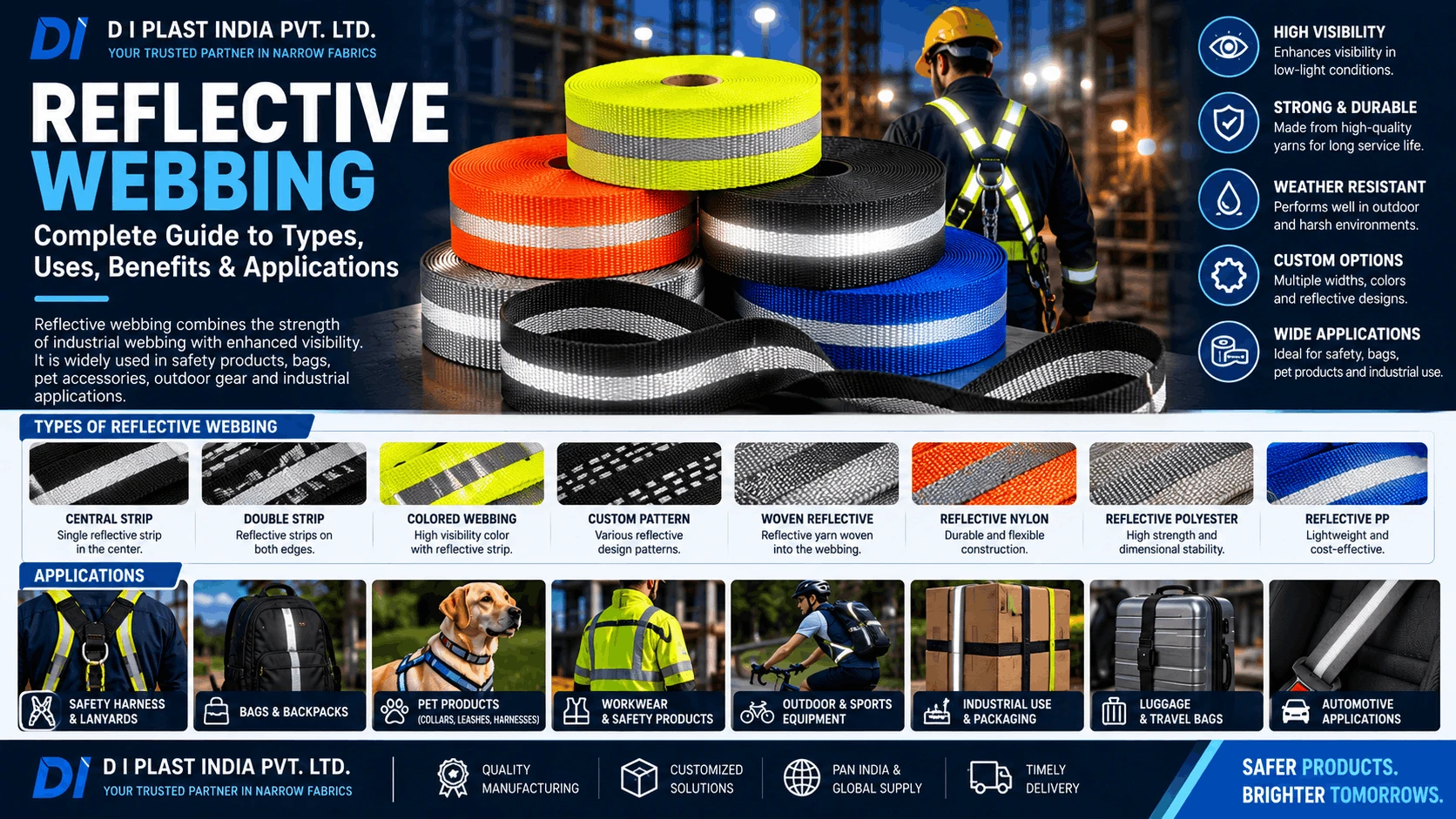
Reflective Webbing: Complete Guide to Types, Uses, Benefits...