A modern vehicle's seat belt is one of its most important safety systems. While the buckle, retractor, pretensioner and other components are highly visible parts of the system, the seat belt webbing is the component that directly restrains the occupant.
Seat belt webbing is a specially engineered narrow woven fabric designed to provide high strength, controlled elongation, flexibility and durability under demanding conditions.
Unlike ordinary textile webbing used for bags or luggage, automotive seat belt webbing must meet much more stringent performance requirements because it forms part of a safety-critical restraint system.
High-tenacity polyester is widely used for automotive seat belt webbing because it provides a useful combination of strength, durability, dimensional stability and resistance to environmental exposure.
At D I PLAST INDIA, high-tenacity polyester is used for car seat belt webbing, with customized tensile strength and color options according to application requirements.
In this guide, we explain:
What seat belt webbing is
Why polyester is commonly used
How seat belt webbing is manufactured
Important webbing properties
How automotive webbing is tested
Seat belt webbing standards
Difference between ordinary and automotive webbing
How to select a manufacturer
Frequently asked questions
Seat belt webbing is the woven textile strap used in an automotive restraint system to hold an occupant securely during sudden braking, collision or rapid deceleration.
It is normally manufactured as a continuous narrow fabric and assembled with components such as:
Retractors
Buckles
Tongues
Anchors
Pretensioners
Height adjusters
Mounting hardware
The webbing must be able to move smoothly through the retractor and hardware while maintaining its required mechanical properties.
The construction of the webbing is therefore carefully controlled during manufacturing.
At first glance, a seat belt may appear similar to a heavy-duty strap used for luggage or bags.
However, the performance requirements are completely different.
A normal bag strap may primarily need:
Good appearance
Flexibility
Abrasion resistance
Adequate strength
Automotive seat belt webbing additionally needs carefully controlled characteristics such as:
Tensile strength
Elongation
Width
Thickness
Weave construction
Edge quality
Surface characteristics
Color fastness
Durability
Compatibility with retractors and hardware
In the United States, FMVSS No. 209 specifies requirements for seat belt assemblies, including webbing width, strength and elongation. NHTSA documentation states that occupant-contacting webbing generally has a minimum width requirement of 46 mm under the specified conditions.
This illustrates why automotive webbing should be treated as an engineered safety component rather than a generic textile strap.
High-tenacity polyester is widely used for automotive seat belt webbing.
The material provides several useful characteristics:
High tensile strength
Low moisture absorption
Good dimensional stability
Controlled elongation
Good abrasion resistance
Good resistance to outdoor exposure
Consistent manufacturing performance
The exact yarn specification and webbing construction are selected according to the requirements of the finished seat belt system.
D I PLAST INDIA's car seat belt webbing product page specifies high-tenacity polyester as the material.
The material used for a safety-critical webbing needs to maintain predictable characteristics over the expected service life.
Polyester provides a useful combination of mechanical and environmental properties.
Polyester absorbs very little moisture compared with many other textile fibers.
This helps maintain more consistent dimensions and behavior when the vehicle is exposed to rain, humidity or changing environmental conditions.
Seat belt webbing cannot simply behave like an elastic strap.
Controlled elongation is important because the webbing needs to perform predictably as part of the complete restraint system.
Automotive webbing may be exposed to repeated cycles of:
Pulling
Retracting
Folding
Rubbing
Temperature changes
Sunlight
Dust
The material and construction therefore need to be selected for long-term durability.
The basic manufacturing process begins with high-tenacity yarn and progresses through several controlled stages.
The manufacturer selects the appropriate polyester yarn based on the required specification.
Important characteristics can include:
Yarn strength
Denier
Filament construction
Color
Consistency
The yarns are arranged into the required warp configuration.
Correct tension is important because variations can affect:
Width
Density
Appearance
Strength
Dimensional consistency
The prepared yarn is woven using a specialized narrow-fabric loom.
Seat belt webbing is commonly produced on needle looms. India's technical-textile industry documentation notes that seat belts are woven from nylon or polyester yarn using needle looms.
The weaving construction determines many of the characteristics of the finished webbing.
The manufacturer controls the webbing's:
Width
Thickness
Thread density
Edge construction
Surface appearance
Consistency is especially important because the finished webbing must work correctly with automotive hardware.
The webbing is dyed to the required color.
Black is widely used in automotive interiors, although other colors may be specified for particular applications.
Color consistency is important when supplying production quantities to automotive customers.
Additional finishing may be used to achieve the required surface characteristics and dimensional stability.
The exact finishing process depends on the webbing construction and customer specification.
Finished webbing is inspected for the specified characteristics.
Typical checks can include:
Width
Thickness
Appearance
Tensile strength
Elongation
Color
Surface quality
Length
Approved webbing is wound into rolls and packed for transportation.
D I PLAST INDIA states that finished rolls are checked for width, strength, length and finishing before dispatch.
Tensile strength is one of the most important properties of automotive webbing.
It represents the force required to break the webbing under specified test conditions.
However, the required strength depends on the applicable regulation, test method, webbing construction and complete restraint system.
For example, FMVSS 209 specifies different breaking-strength requirements for Type 1 and Type 2 belt assemblies.
Therefore, manufacturers should always specify the applicable test standard rather than relying on a generic tensile-strength number.
Width is another critical characteristic.
For example, FMVSS 209 specifies a minimum webbing width of 46 mm for relevant portions of seat belt assemblies under its specified conditions.
The purpose of minimum width requirements is not simply appearance.
A sufficiently wide belt helps distribute restraint forces across the occupant rather than concentrating them over a smaller area. NHTSA specifically explains this rationale in its interpretation of the webbing-width requirement.
Elongation describes how much the webbing extends when subjected to a specified load.
Controlled elongation is important for automotive restraint systems.
FMVSS 209 includes specific elongation requirements at specified loads for different belt types.
The appropriate target therefore depends on the applicable standard and complete seat belt design.
Seat belt webbing needs consistent edges because it passes through:
Retractors
Guides
Adjusters
Buckles
Other hardware
Poorly formed edges can affect handling, appearance and long-term durability.
Consistent weaving and finishing help produce a webbing that performs reliably in the final assembly.
A seat belt needs to move smoothly through the retractor and associated hardware.
Surface construction and finishing can therefore influence:
Friction
Retracting behavior
Wear
Folding
User comfort
The exact surface requirements depend on the restraint-system design.
Automotive webbing is often integrated into the vehicle interior.
As a result, appearance and color consistency matter.
The webbing should maintain the specified appearance throughout production and should be evaluated for appropriate color fastness and environmental exposure according to the customer's requirements.
Seat belt requirements vary depending on the target market.
In the United States, Federal Motor Vehicle Safety Standard No. 209 covers seat belt assemblies.
It includes requirements concerning:
Webbing
Width
Strength
Elongation
Hardware
Assembly performance
Marking
Workmanship
NHTSA's laboratory test procedure provides specific test requirements for seat belt assemblies.
UN Regulation No. 16 addresses safety-belts and restraint systems and is widely recognized internationally.
UNECE describes Regulation No. 16 as a widely internationally recognized requirement for safety belts and related systems.
The exact regulatory requirements depend on the vehicle category, market and approval route.
A roll of webbing should not be described as "certified" for a complete vehicle restraint system simply because it has passed an individual webbing test.
The final seat belt assembly must meet the requirements applicable to the complete product.
Both products are safety-critical, but they serve different applications.
Feature | Seat Belt Webbing | Safety Harness Webbing |
|---|---|---|
Primary application | Vehicle occupant restraint | Fall protection |
Typical material | High-tenacity polyester | Polyester or nylon |
Main system | Vehicle restraint | Personal fall-arrest system |
Key components | Retractor, buckle, anchor | D-rings, buckles, stitching |
Standards | Automotive regulations | Fall-protection standards |
Design priority | Controlled occupant restraint | Fall arrest and load distribution |
The two products should not be automatically substituted for one another.
Seat belt assemblies can have different configurations.
A two-point belt generally restrains the occupant across the lap or another designated region depending on the application.
These systems can be used in:
Buses
Commercial vehicles
Special-purpose vehicles
Industrial seating
Aviation and other applications
A three-point seat belt combines a lap portion and shoulder portion.
It is widely used in passenger vehicles because it restrains the occupant across the pelvis and upper torso.
The webbing must therefore work correctly with the retractor, buckle and mounting system.
Selecting a supplier is an important part of automotive sourcing.
The manufacturer should have reliable control over yarn specifications and incoming material quality.
The supplier should have suitable machinery and technical expertise for automotive webbing.
Manufacturing parameters should be controlled to minimize batch-to-batch variations.
The supplier should have appropriate testing procedures for the required specification.
Production batches should be identifiable so that material can be traced to manufacturing records.
Automotive customers may require specific:
Width
Thickness
Color
Tensile strength
Construction
Roll length
Packaging
A capable supplier should be able to work to defined specifications.
D I PLAST INDIA Pvt. Ltd. manufactures car seat belt webbing using high-tenacity polyester for automotive applications.
The company's product specifications include customized tensile strength and color options, with application-specific usage.
D I PLAST INDIA's broader product range includes:
Car seat belt webbing
Seat belts
Safety harnesses
Nylon webbing
Polyester webbing
PP webbing
Printed webbing
Tubular webbing
Army vest webbing
Pet webbing
Industrial webbing
The company identifies automobile and aviation as key industries served, including car seatbelt webbing and two-point and three-point seatbelt products.
For automotive buyers, consistency and technical support are just as important as the product itself.
D I PLAST INDIA focuses on:
Consistent webbing quality
Application-specific specifications
Customized colors
Customized tensile requirements
Controlled width and thickness
Quality inspection
Bulk manufacturing
Domestic and export supply
The company has also built its product portfolio around several technical-webbing applications, allowing customers to source different narrow-fabric requirements from one manufacturer.
Before requesting a quotation, provide your supplier with as much information as possible.
Specify the required fiber, such as high-tenacity polyester.
Provide the required finished width and tolerance.
Specify the required thickness or provide a physical sample.
State the required tested breaking strength and test method.
Specify the required elongation criteria where applicable.
Provide a color code, reference sample or approved standard.
Explain whether the webbing will be used in:
Passenger cars
Buses
Commercial vehicles
Industrial seating
Aviation
Other applications
Clearly identify the regulatory or customer specification against which the product needs to be evaluated.
A seat belt is a safety-critical system.
The webbing therefore needs to perform consistently throughout its intended service life.
Variations in:
Yarn quality
Weave density
Width
Thickness
Finishing
Tensile strength
Elongation
can affect the behavior of the final assembly.
This is why automotive manufacturers should work with suppliers that understand both narrow-fabric manufacturing and application-specific quality requirements.
Seat belt webbing is much more than a woven polyester strap.
It is an engineered automotive safety component that must combine strength, controlled elongation, dimensional consistency, durability, flexibility and compatibility with the complete restraint system.
High-tenacity polyester is widely used because it provides a strong combination of mechanical and environmental characteristics.
However, selecting the correct webbing requires more than choosing the material. Width, thickness, construction, tensile performance, elongation, finishing, testing and applicable regulations must all be considered.
For automotive manufacturers, OEMs, seat belt assemblers and component buyers, working with an experienced webbing manufacturer can help ensure consistent supply and application-specific product development.
High-tenacity polyester is widely used for automotive seat belt webbing. D I PLAST INDIA specifies high-tenacity polyester for its car seat belt webbing.
The required width depends on the applicable regulation and application. For example, FMVSS 209 specifies a minimum 46 mm width for relevant occupant-contacting webbing under its specified conditions.
No. Although both may use polyester, automotive seat belt webbing has application-specific construction and performance requirements and is intended for a safety-critical restraint system.
The required strength depends on the applicable standard, belt type and test method. FMVSS 209, for example, specifies different breaking-strength requirements for different seat belt assemblies.
Yes. Depending on the application, manufacturers can work with customers on specifications such as tensile strength, color and construction. D I PLAST INDIA lists customized tensile strength and color options for its car seat belt webbing.
Nylon has been used for seat belt webbing, but the appropriate material depends on the applicable vehicle regulation, product design and customer specification. Automotive requirements should always be checked before selecting or changing material.
A two-point belt generally restrains the occupant across a designated section such as the lap, while a three-point belt incorporates both lap and upper-torso restraint.
D I PLAST INDIA Pvt. Ltd. manufactures car seat belt webbing using high-tenacity polyester and supplies customized automotive webbing solutions.
D I PLAST INDIA Pvt. Ltd. manufactures high-tenacity polyester seat belt webbing for application-specific automotive requirements.
Share your required width, tensile strength, color, construction, quantity and application with our team to discuss your requirement.

Industrial nylon webbing safety belts are essential safety p...
Industrial safety belts for maximum protection are specially...

Reliable safety harness solutions are an important part of w...
Narrow woven fabric tape manufacturing plays an important ro...
Durable slipper strap manufacturing solutions are essential...

High strength industrial woven tapes are designed for indust...

What Is Industrial Webbing?Industrial webbing is a high-stre...

Nylon vs Polyester vs Polypropylene Webbing: Which One Shoul...

How Is Industrial Webbing Manufactured? A Step-by-Step Guide...

Safety Harness Webbing: Complete Guide to Materials, Strengt...

Bag & Luggage Webbing: Complete Guide to Materials, Type...

Polyester Webbing: Complete Guide to Types, Strength, Uses &...

Nylon Webbing: Complete Guide to Strength, Types, Uses &...

PP Webbing: Complete Guide to Polypropylene Webbing, Uses, B...
Safety Lanyards: Complete Guide to Types, Materials, Applica...
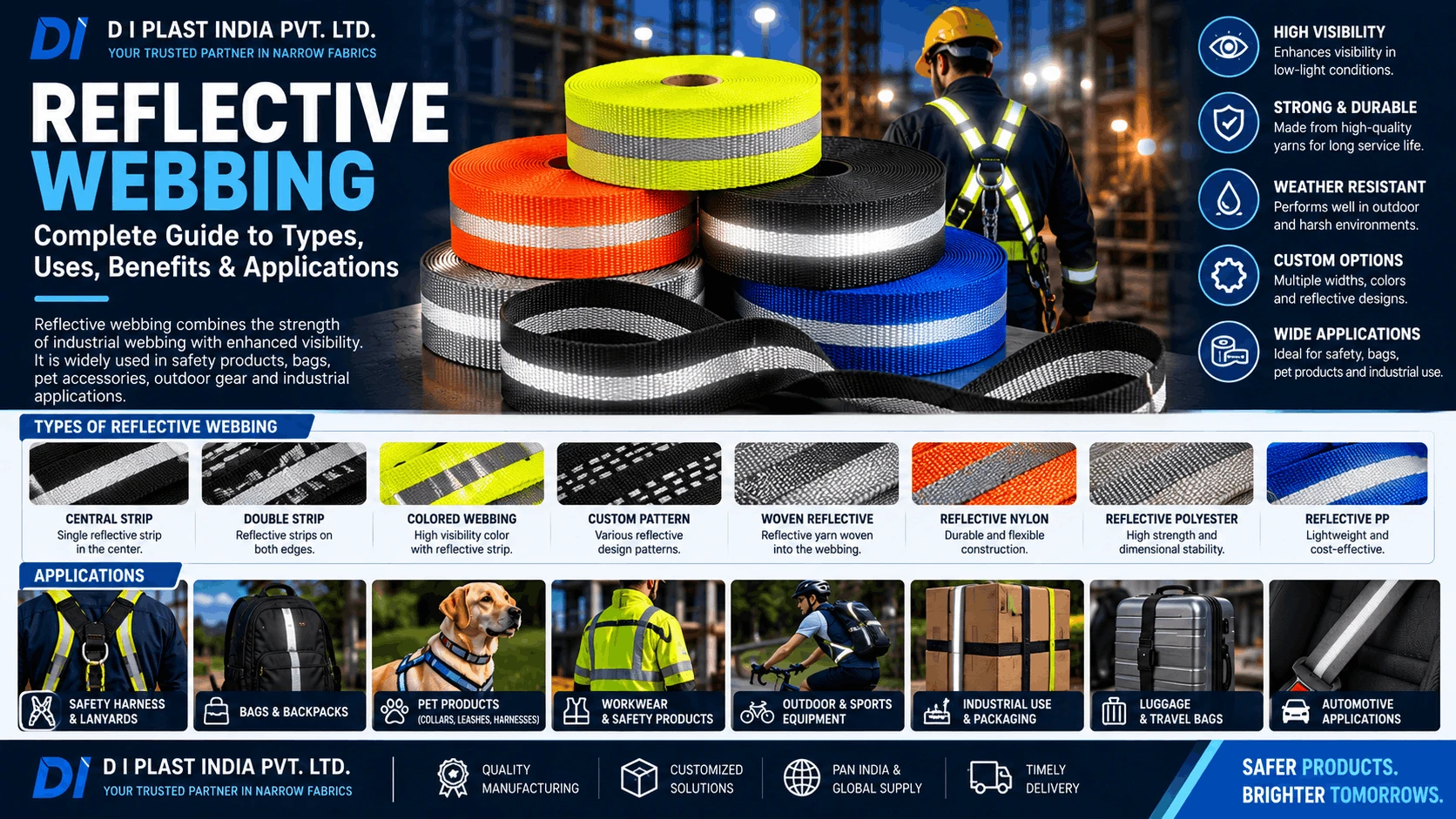
Reflective Webbing: Complete Guide to Types, Uses, Benefits...