PP webbing, also known as polypropylene webbing, is a lightweight and versatile narrow woven fabric used across bags, luggage, packaging, pet products, furniture, safety products and industrial applications.
Polypropylene is particularly attractive for webbing because it combines low weight, moisture resistance, flexibility and cost efficiency.
For manufacturers, the material can also be produced in different widths, thicknesses, colors, designs and constructions, making PP webbing suitable for both functional and decorative applications.
D I PLAST INDIA manufactures and supplies PP webbing for applications including bags, luggage, packaging, pet accessories, safety products, furniture and industrial products. The company states that its PP webbing is manufactured using polypropylene yarns and is available in customized widths, colors, thicknesses and designs.
This guide explains what PP webbing is, its advantages and limitations, common applications, manufacturing process, PP versus polyester and nylon, and what buyers should consider when selecting a PP webbing manufacturer.
PP webbing is a narrow woven textile manufactured from polypropylene yarn.
The abbreviation PP stands for polypropylene.
Unlike conventional fabric, webbing is manufactured in narrow continuous widths and is commonly used to create:
Straps
Handles
Belts
Loops
Reinforcement
Tie-down components
Packaging straps
Pet products
Furniture straps
The finished webbing can be produced in different constructions according to the requirements of the application.
Its relatively lightweight construction makes polypropylene particularly useful where manufacturers want to control the weight and cost of the finished product.
Polypropylene has several characteristics that make it useful for webbing.
One of the key advantages of polypropylene is its low density.
This allows manufacturers to produce lightweight straps without unnecessarily adding weight to the finished product.
This can be particularly useful for:
Bags
Backpacks
Packaging
Utility products
Lightweight straps
Polypropylene has very low moisture absorption.
This makes PP webbing useful in products that may encounter:
Humidity
Rain
Water
Damp environments
However, the presence of polypropylene does not automatically make the complete product waterproof. The overall construction and stitching also matter.
PP webbing can be an economical choice for applications where manufacturers require practical performance at a competitive cost.
This makes it particularly attractive for high-volume products such as:
Shopping bags
School bags
Promotional bags
Packaging straps
Utility products
Depending on its construction and finishing, PP webbing can provide a flexible strap that is easy to handle and stitch.
The final flexibility depends on:
Yarn specification
Weave
Thickness
Density
Finishing
PP webbing can be manufactured in multiple:
Widths
Thicknesses
Colors
Designs
Constructions
D I PLAST INDIA specifically states that its PP webbing is available in multiple widths, colors, thicknesses and designs and can be tailored to application requirements.
PP webbing has applications across several industries.
PP webbing is commonly used for:
Bag straps
Handles
Adjustment straps
Reinforcement
Attachment loops
For cost-sensitive bag manufacturing, PP can offer a practical combination of weight, flexibility and cost.
D I PLAST INDIA identifies bag straps and PP webbing within its bag and sports industry applications.
PP webbing can be incorporated into:
Travel bags
Duffel bags
Luggage straps
Handles
Internal securing systems
The appropriate construction depends on the expected load and how the webbing interacts with the luggage hardware.
Packaging is another important application.
PP webbing can be used for:
Pallet straps
Cargo securing
Packaging belts
Load restraint
Industrial packaging
D I PLAST INDIA lists pallet belts for packaging among its products, reflecting the use of webbing in packaging and logistics applications.
For load-bearing or cargo-securing applications, however, the required specification should be based on the actual load, system design and applicable requirements rather than simply selecting generic PP webbing.
PP webbing can be used for selected:
Dog collars
Pet leashes
Pet harnesses
Pet accessories
The choice between PP, nylon and polyester depends on the desired combination of strength, flexibility, appearance, cost and environmental exposure.
D I PLAST INDIA lists dog collars, dog harnesses and other pet products among its industry applications.
Webbing can be used in furniture manufacturing for selected applications such as:
Chair straps
Seat support
Outdoor furniture
Reinforcement
Upholstery components
The required construction depends on the furniture design and expected load.
PP webbing can be used in certain general-purpose safety and industrial products.
However, not every PP webbing is suitable for certified personal protective equipment or fall-protection systems.
For safety-critical applications, manufacturers should specify the required standard and test the complete product or assembly.
PP webbing can be used for:
Utility straps
Packaging
Equipment straps
Industrial reinforcement
General-purpose narrow fabric applications
The appropriate webbing construction depends on the mechanical and environmental requirements.
One of the most common purchasing decisions is whether to choose polypropylene or polyester.
Property | PP Webbing | Polyester Webbing |
|---|---|---|
Weight | Very lightweight | Moderate |
Moisture absorption | Very low | Low |
Strength | Moderate to high | High |
UV resistance | Application-dependent | Generally very good |
Cost | Generally economical | Generally higher |
Flexibility | Good | Very good |
Dimensional stability | Good | Excellent |
Typical applications | Bags, packaging, utility products | Industrial, automotive, safety, bags |
Main advantage | Lightweight and cost efficiency | Strength and dimensional stability |
These are general characteristics. Actual performance depends on the yarn and webbing construction.
You may consider PP when your priorities include:
Low weight
Cost efficiency
Moisture resistance
General-purpose performance
High-volume production
Polyester may be more suitable where the application requires:
Higher mechanical performance
Better dimensional stability
Low stretch
Greater environmental durability
The correct choice should always be based on the finished product requirements.
PP is also frequently compared with nylon.
Property | PP Webbing | Nylon Webbing |
|---|---|---|
Weight | Lightweight | Moderate |
Strength | Moderate to high | High |
Flexibility | Good | Excellent |
Abrasion resistance | Good | Excellent |
Moisture absorption | Very low | Higher |
Cost | Generally lower | Generally higher |
Typical use | Bags, packaging, utility | Technical, heavy-duty, bags |
Key advantage | Lightweight and economical | Toughness and flexibility |
Nylon may be preferred for demanding dynamic applications, while PP can be attractive where weight and cost are major considerations.
There is no single tensile strength for PP webbing.
Strength depends on:
Polypropylene yarn specification
Yarn denier
Number of yarns
Weave construction
Width
Thickness
Density
Finishing
A wider PP webbing with a higher yarn density may have significantly different tensile performance from a narrow lightweight webbing.
Therefore, buyers should specify the required tensile strength, width and test method rather than simply requesting "strong PP webbing."
PP webbing can have some elongation under load.
The amount depends on:
Yarn construction
Weave
Density
Finishing
Applied load
For applications where very low stretch is important, buyers should compare PP with polyester and select the material based on the actual application requirements.
Polypropylene has very low moisture absorption, which gives PP webbing good resistance to water absorption.
However, calling a complete strap or product "waterproof" requires consideration of the entire construction.
Factors such as:
Stitching
Seams
Coatings
Hardware
Attached fabric
can influence the water resistance of the finished product.
It is more accurate to describe PP webbing as having very low moisture absorption rather than assuming every PP webbing product is completely waterproof.
UV performance depends on the specific polypropylene formulation, color, stabilizers and intended application.
For products that remain outdoors for extended periods, the manufacturer should be informed about the expected UV exposure.
This allows the webbing specification to be selected appropriately.
For long-term outdoor applications where UV exposure is a major concern, polyester may also be considered.
PP webbing can be manufactured in different widths depending on the intended application.
Potential applications:
Small loops
Adjustment straps
Lightweight bags
Utility products
Potential applications:
Backpack straps
Bag handles
Luggage
Pet products
Potential applications:
Packaging
Industrial products
Furniture
Heavy-duty utility applications
The correct width depends on the expected load, product design and hardware.
Thickness affects the physical characteristics of the finished strap.
It can influence:
Stiffness
Flexibility
Appearance
Stitching
Hardware compatibility
Handling
However, thickness should not be treated as a direct measurement of tensile strength.
Two webbing products with identical thickness can have different strength values because their yarn and weave constructions are different.
The basic manufacturing process involves several stages.
The appropriate polypropylene yarn is selected according to the required construction.
The yarn specification can influence the strength, appearance and handling of the finished webbing.
Yarns are arranged and prepared for the weaving process.
Maintaining consistent tension helps achieve uniform webbing.
The yarns are woven using narrow-fabric weaving equipment.
The weaving process controls characteristics such as:
Width
Density
Pattern
Thickness
Edge construction
The webbing can be manufactured in the required colors.
For commercial products, color consistency between batches is important.
D I PLAST INDIA highlights fade-resistant colors as a feature of its PP webbing and states that quality dyes are used for long-lasting color retention.
Finishing processes may be used to achieve the desired:
Surface feel
Flexibility
Appearance
Handling characteristics
Finished webbing can be checked for:
Width
Thickness
Strength
Length
Appearance
Color
Finishing
D I PLAST INDIA states that its production batches undergo inspection and testing before dispatch and that every roll is checked for width, strength, length and finishing.
Approved webbing is wound into rolls and packed for delivery.
Proper packaging helps protect the material during transportation and storage.
A high-quality PP webbing product should have consistent:
Width
Thickness
Weave
Edge quality
Color
Strength
Roll length
Finish
Consistency is particularly important for manufacturers using webbing in repetitive production processes.
Variations can affect:
Stitching
Hardware insertion
Product appearance
Material consumption
Production efficiency
Variation in width can create problems when the webbing passes through buckles or other hardware.
Excessive fraying can affect appearance and durability.
This may cause problems during stitching and assembly.
Different production batches may not match.
This can create problems when the webbing is subjected to repeated loads.
An inconsistent weave can affect appearance and mechanical performance.
Yes.
PP webbing can be customized according to the manufacturer's capabilities.
Common customization requirements include:
Width
Thickness
Color
Weave
Tensile strength
Roll length
Packaging
Design
For branding applications, manufacturers may also consider:
Printed webbing
Custom patterns
Special color combinations
D I PLAST INDIA specifically states that its PP webbing can be tailored to customer requirements and is available in different widths, colors, thicknesses and designs.
One of the most common applications is bag manufacturing.
PP webbing can be used for:
Handles
Shoulder straps
Adjustment straps
Loops
Reinforcement
It is particularly attractive for products where cost and weight need to be controlled.
For premium bags requiring specific appearance, feel or higher performance, polyester or nylon may be considered as alternatives.
Packaging and logistics applications can require straps that are lightweight and easy to handle.
PP webbing may be used in:
Pallet packaging
Load securing
Bundling
Industrial packaging
Reusable transport systems
However, where the webbing is being used as a critical load-restraint component, the required load rating and applicable standard should be clearly established.
PP webbing can be used in selected pet products where manufacturers want:
Lightweight construction
Color variety
Moisture resistance
Cost efficiency
Applications include:
Collars
Leashes
Harnesses
For products intended for large or strong animals, the complete product—including stitching and hardware—should be evaluated for the expected load.
Furniture webbing may be used as a structural or support component in selected designs.
Potential applications include:
Chair seating
Outdoor furniture
Sofa support
Straps
Reinforcement
The appropriate construction depends on the furniture design and expected loading conditions.
Before placing an order, consider the following.
Tell the manufacturer exactly where the webbing will be used.
For example:
Bag / Luggage / Packaging / Furniture / Pet Product / Industrial
Specify the finished width and tolerance.
Provide the desired thickness or an existing sample.
Provide a:
Pantone reference
Color code
Physical sample
Specify the required strength and test method if applicable.
Provide your expected monthly or annual consumption.
Specify the required length per roll.
Mention any requirements for:
Printing
Special finishing
Custom weave
Packaging
Branding
For regular and bulk requirements, buying directly from a manufacturer can offer several advantages.
The product can be developed around the customer's requirements.
Direct manufacturing allows better control over production parameters.
Large-volume requirements can be planned according to production capacity.
The manufacturer can help determine suitable width, thickness and construction.
The supplier can control the process from yarn selection through final inspection.
D I PLAST INDIA states that it uses high-quality polypropylene yarns, modern manufacturing technology and quality-control procedures for its PP webbing.
D I PLAST INDIA Pvt. Ltd. manufactures and supplies PP webbing for a variety of industries.
Its current PP webbing product page identifies applications including:
Bags
Luggage
Packaging
Pet accessories
Safety products
Furniture
Industrial applications
The company states that its PP webbing offers a combination of strength, flexibility and durability, while its lightweight construction provides easy handling.
The company's broader product range also includes polyester webbing, nylon webbing, printed webbing, tubular webbing, bag straps, shoulder straps and other narrow-fabric products.
This allows buyers to discuss different material options when one material is not suitable for the application.
The simplest way to approach material selection is to start with your application.
Low weight is important
Cost efficiency matters
Very low moisture absorption is useful
The application is general-purpose
Large quantities are required
Higher mechanical performance is needed
Low stretch is important
Dimensional stability matters
Outdoor exposure is significant
Flexibility is important
High toughness is required
Abrasion resistance is a major consideration
The product experiences repeated dynamic loading
There is no universally "best" webbing material.
The correct choice is the one that provides the required performance at the right cost for the application.
PP webbing is a narrow woven fabric manufactured from polypropylene yarn and used for straps, bags, luggage, packaging, pet products, furniture and industrial applications.
PP stands for polypropylene, a lightweight synthetic polymer used to manufacture yarn and narrow woven products.
Yes. PP webbing can provide useful tensile strength, although the actual strength depends on the yarn, width, thickness and weave construction.
Polypropylene has very low moisture absorption, but the complete webbing product should not automatically be described as waterproof.
PP is generally considered a more economical material for many general-purpose applications, although actual pricing depends on yarn specification, construction, quantity and market conditions.
Yes. PP webbing is widely suitable for bag handles, straps, loops and reinforcement, particularly where lightweight and cost-efficient construction is desired.
Yes, depending on the required load and construction. The webbing should be selected to match the luggage design and hardware.
Yes. PP webbing can be customized in areas such as width, thickness, color, design and construction depending on the supplier's manufacturing capabilities.
Printed PP webbing can be produced for selected branding and decorative applications. The printing method should be chosen according to the polypropylene construction and required durability.
PP is lighter and generally more economical, while nylon is known for higher toughness, flexibility and abrasion resistance.
PP is generally lighter and more cost-efficient, while polyester generally offers higher mechanical performance, lower stretch and stronger dimensional stability.
D I PLAST INDIA Pvt. Ltd. manufactures and supplies PP webbing for bags, luggage, packaging, pet products, furniture, safety and industrial applications.
D I PLAST INDIA Pvt. Ltd. manufactures PP webbing and customized polypropylene webbing for bags, luggage, packaging, pet products, furniture and industrial applications.
For a quotation, share:
Width + Thickness + Color + Tensile Strength + Application + Quantity
Our team can help determine the appropriate PP webbing construction for your requirement.

Industrial nylon webbing safety belts are essential safety p...
Industrial safety belts for maximum protection are specially...

Reliable safety harness solutions are an important part of w...
Narrow woven fabric tape manufacturing plays an important ro...
Durable slipper strap manufacturing solutions are essential...

High strength industrial woven tapes are designed for indust...

What Is Industrial Webbing?Industrial webbing is a high-stre...

Nylon vs Polyester vs Polypropylene Webbing: Which One Shoul...

How Is Industrial Webbing Manufactured? A Step-by-Step Guide...

Safety Harness Webbing: Complete Guide to Materials, Strengt...

What Is Seat Belt Webbing? Complete Guide to Automotive Safe...

Bag & Luggage Webbing: Complete Guide to Materials, Type...

Polyester Webbing: Complete Guide to Types, Strength, Uses &...

Nylon Webbing: Complete Guide to Strength, Types, Uses &...
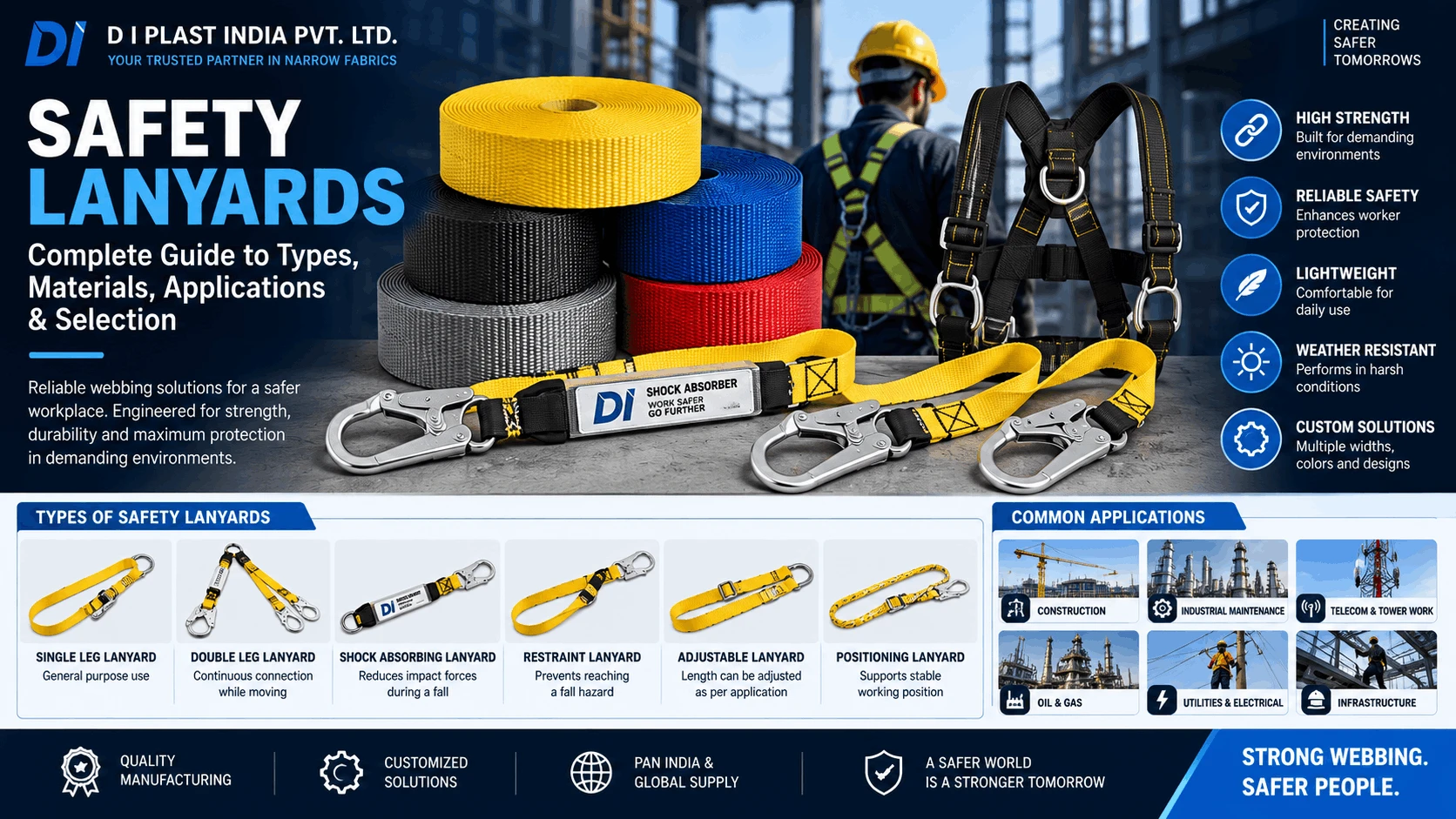
Safety Lanyards: Complete Guide to Types, Materials, Applica...
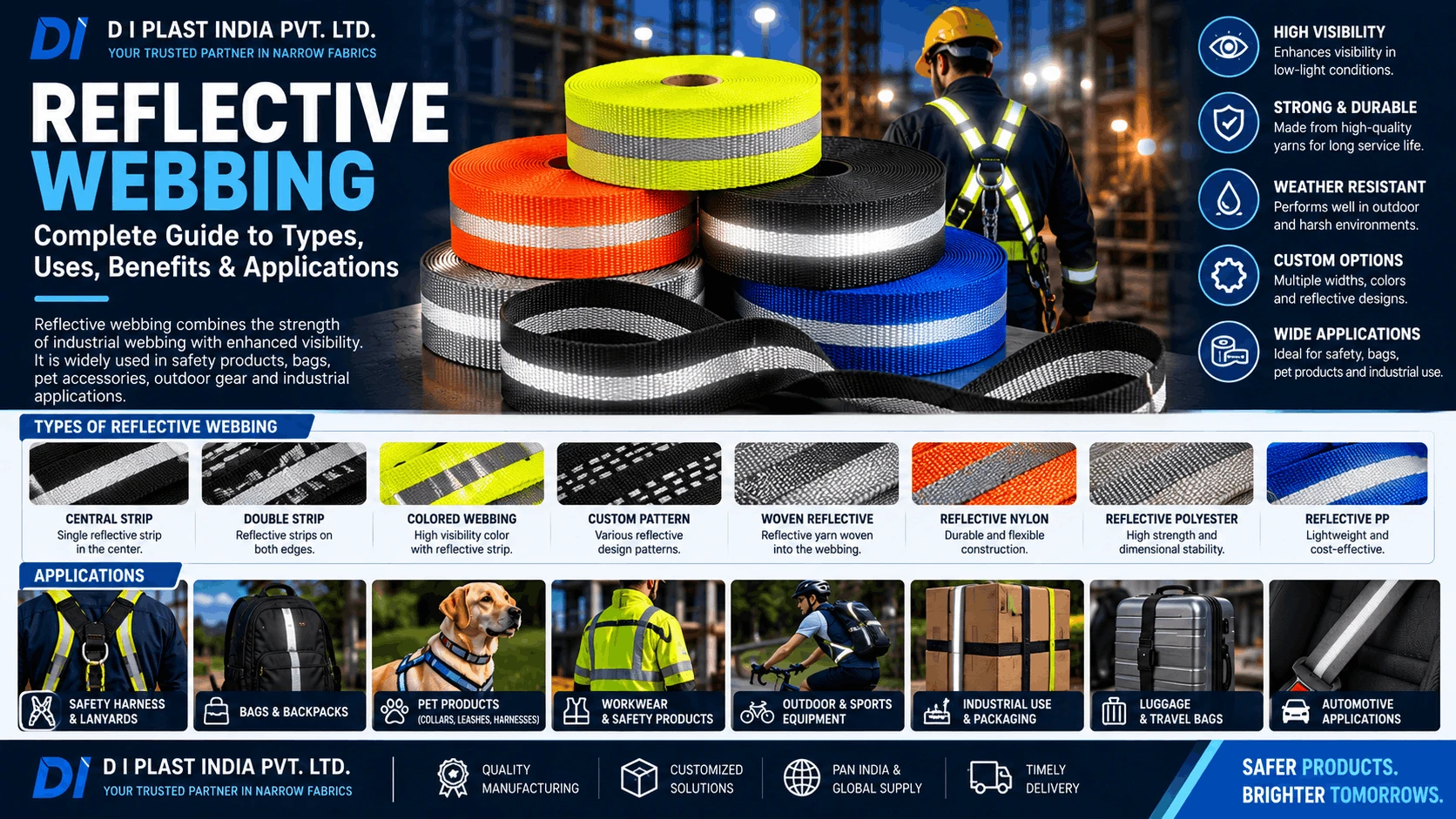
Reflective Webbing: Complete Guide to Types, Uses, Benefits...